

 English
 Deutsch
 Español
 Français
 Italiano
 Nederlands
 Dansk
 Svenska
 Norsk
 Czech
 Polski
 Português

The Future of Industrial Knives: Innovations Redefining Precision and Performance


Future of Industrial Knives: Innovations Redefining Precision and Performance
In many ways industrial knives are a critical element of most production processes, including cutting food, cutting paper, and recycling plastic, and of almost all industries, though they are underappreciated. The quality of industrial knives determines the quality of a company’s products.
Therefore, progress in the production of industrial knives is an important element of industrial competitiveness. Technological advances have improved the expectations for blades used in manufacturing processes.Knives now last longer, cut cleaner, and fit more tightly into automated systems than ever before.
In this article, Baucor explores the innovations redefining precision and performance, with a close look at industrial knives for food processing, slicer blades, industrial machine knives, and how to choose the right industrial blades and knives for your operation.
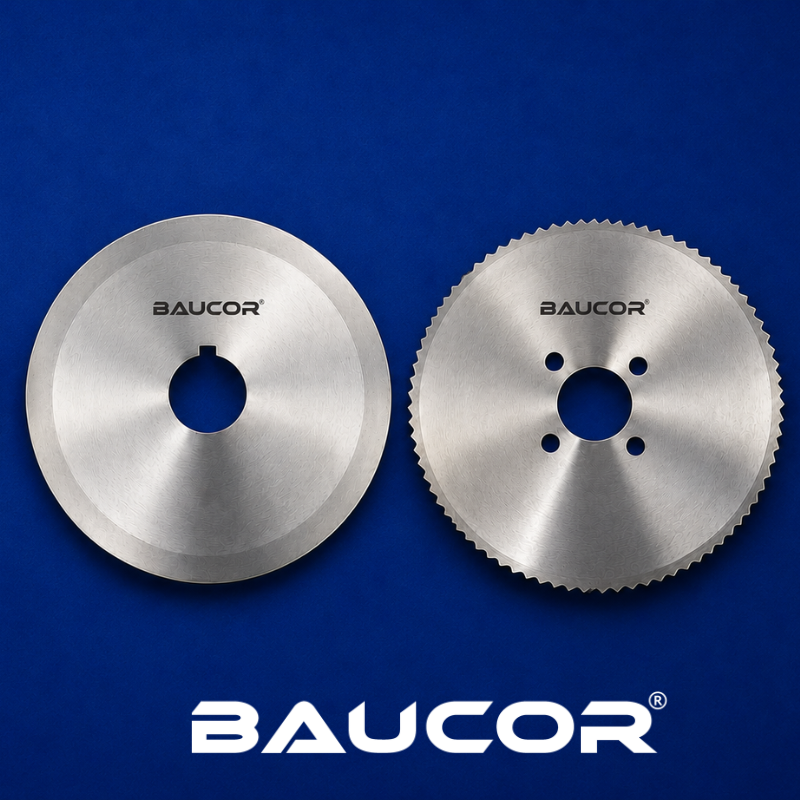
Advanced Materials: Stronger, Harder, Longer-Lasting Blades
- A change in industrial knife composition is one of the most significant changes in industrial knives in many years.
- Engineered steels now hold more industrial cutting applications, particularly with Powdered Metals (PM). The refinement of the microstructure with PM means a longer cutting edge and greater chip resistance.
- Tungsten carbide is extremely wear resistant and works great on abrasive cutting jobs such as paper and nonwoven fabrics.
- For corrosion and chemical resistance, use ceramic or ceramic composite industrial knives.
- Corrosion-resistant stainless grades are being refined to balance hardness with the toughness needed for washdown environments.
The trend is clear: instead of one blade fitting every job, manufacturers now match the material to the product, the machine, and the cut.
Coatings and Edge Engineering: Performance at the Micron Level
A blade's surface and edge geometry are as important as the core material itself. Current blade coatings and finishing methods have allowed the machine to remain the same while improving cut quality and extending the life of the blades.
- Coating systems like PVD and CVD using titanium nitride (TiN), titanium carbonitride (TiCN), or chromium nitride (CrN) create a wear resistant layer on a blade and can also decrease the coefficient of friction.
- Diamond like carbon (DLC) coatings go further by reducing friction and letting the blades pass through sticky and adhesive substances.
- Non stick coating products stop adhesion, and when applied, mean cutting cheese, dough or sugary substances is simple and mess free.
- The application of precision grinding and honing via CNC machines enables consistent edge geometry and bevel angles on blades. Now every blade of the set behaves as the rest.
- Advanced manufacturing techniques have now enabled blade profiling, such as laser cutting, that maintains precision and minimizes thermal damage of the blade.
Combined, the innovations have led to smoother blade operation and more precise cutting. Changes in blade life have become more predictable and less frequent.
Industrial Knives for Food Processing: Hygiene, Safety, and Yield
Food production probably is the sector with the most stringent requirements for blade use. Industrial blades for the processing of food must cut in a single, high speed motion. Also, blades used for food must be wash-down resistant and meet a number of food safety standards.
Key Innovations in this Area Include:
- Food grade Stainless Steels which provide resistance against brine, cleaning chemicals, and acid food products.
- Innovative food-processing blades that feature reduced crevices and an overall smooth design to ensure bacteria is less likely to survive on the blade surface.
- Edge geometries tuned to the product, from scalloped edges for bread to fine straight edges for meat and poultry.
- Non-stick and low-friction coatings that keep cheese, confectionery, and dough from smearing or sticking.
- Metal-detectable components in blade holders and guards to support contamination-control programs.
The payoff goes beyond sanitation. A sharper, more consistent blade tears less product, which means better portion accuracy, less waste, and higher yield on every shift.
The Slicer Blade for Food Processor Lines: Precision in Every Slice
Precision for the consumer is evident when viewing the slicer blade on food processing equipment. In food processing, precision looks better when products are neatly stacked, and cooked more evenly at home when uniform in thickness.
High-performance blades utilize the following technologies to perform at high-speeds and produce consistent product:
- High-speed tolerance consistency, where a circular blade remains flatter than the thickness requirement of a straight blade.
- Balanced involute blades. Reduced blade speed when unbalanced and higher vibration when unoptimized cause more rapid wear. Reduced vibration in the slicer and protected bearing life.
- Optimized bevel angles for the product, softer foods needing a keener edge and frozen or dense products needing a stronger one.
- Serrated, scalloped, and smooth edge options matched to texture, so the blade slices instead of crushing.
The result is a slicer that holds its accuracy longer, needs fewer adjustments, and turns out a more attractive, more saleable product.
Industrial Machine Knives in the Age of Automation
As factories automate, industrial machine knives are becoming smarter and more tightly integrated with the equipment around them. Blades are no longer just consumables; they are precision components in a connected system.
- Tighter tolerances for robotic and high-speed lines Automated cutting depends on blades that are dimensionally identical, so changeovers happen without recalibration.
- Quick-change blade systems reduce downtime and make blade swaps safer for operators Sensor-assisted monitoring tracks vibration, cutting force, and temperature to signal when a blade is dulling, enabling predictive maintenance instead of guesswork.
- Digital design and simulation let engineers test blade geometry virtually before a single piece of steel is cut.
- Industry-specific designs serve packaging, paper and converting, plastics and film, rubber and tire, woodworking, metal coil processing, and recycling.
These advances help plants run longer between changes, catch problems early, and keep output consistent across shifts.
Sustainability and Total Cost of Ownership
The industrial knives of the future will be more sustainable. For example, a longer blade means fewer replacements, less waste and scrap steel, and fewer shipments.
It is common practice for companies to evaluate the total cost of ownership as opposed to just the purchase price. For instance, an premium quality blade, even if priced at several times that of the competition, can significantly reduce the total cost over time due to longer life and a reduced volume of waste, among other benefits.
An extension of this program includes the regrinding and reconditioning of old, worn-out blades. As carbide is a valuable material, regrinding worn-out blades allows the carbide to be kept in the production system. Additionally, as cutting processes are made cleaner, waste is also eliminated at the source.
How to Choose the Right Industrial Blades and Knives
Selecting industrial blades and knives starts with the material you cut and the machine you run. These questions will guide the decision:
| Factor | What to consider |
|---|---|
| Material being cut | Soft, sticky, abrasive, frozen, fibrous, or layered |
| Blade material | Tool steel, PM steel, stainless, carbide, or ceramic |
| Edge geometry | Bevel angle, edge style (straight, serrated, scalloped), edge radius |
| Coating | Wear-resistant, low-friction, non-stick, or none |
| Operating environment | Washdown, heat, chemicals, food-contact rules |
| Machine fit | OEM dimensions, tolerances, mounting, balance |
| Lifecycle | Expected blade life, regrind options, total cost of ownership |
Working with a knife manufacturer that understands both the application and the machine is the fastest way to get these choices right.
Why Baucor: Precision Built for What Comes Next
At Baucor, we design and manufacture industrial knives that keep pace with these innovations. Our team works with manufacturers across food processing, packaging, converting, plastics, recycling, and beyond to engineer blades that fit the application, not just the machine.
- Custom and OEM-compatible designs built to your drawings, samples, or specifications.
- Material and coating expertise to match each blade to the product it cuts.
- Precision manufacturing for consistent tolerances from the first blade to the thousandth.
- Food-grade options including slicer blades for food processor lines and other industrial knives for food processing.
- A full range of industrial machine knives, from circular and straight blades to perforating, serrated, and specialty profiles.
Conclusion
The future of industrial knives is being shaped by smarter materials, advanced coatings, precision grinding, and connected manufacturing. For businesses that rely on clean, consistent cuts, these innovations translate directly into higher yield, less downtime, and lower cost per cut.
Whether you need a high-precision slicer blade, hygienic industrial knives for food processing, or durable industrial blades and knives for demanding machinery, Baucor is ready to help. Contact Baucor today to discuss your application and find the blade that will define your line's performance for years to come.
Frequently Asked Questions
What are industrial knives?
Manufacturing and processing equipment rely on industrial blades to cut, slit, perforate, slice, and shear a variety of materials including paper, film, food, rubber, textiles and even metal. They come in straight, circular and specialty shapes.
What is the best material for industrial knives?
It depends on what you cut. Stainless steel suits food processing, D2 and M2 steels suit general converting and shearing, and tungsten carbide suits abrasive materials and long runs. An engineer can recommend the right material for your application.
What are industrial knives for food processing made of?
Most are made from hardened 400-series stainless steel for corrosion resistance and edge retention. Hard chrome, non-stick coatings or ceramic may be used for aggressive washdowns or sticky products.
What is the difference between industrial machine knives and hand knives?
Industrial machine knives are mounted in production machines and built to tight tolerances for repeatable, high-speed cutting. Hand knives are held and guided by an operator.
When should I choose custom industrial knives?
Choose custom knives when standard blades don't fit your machine, wear out too fast, or produce poor cut quality. A custom blade can be made from a drawing, a sample or a description of the application,
How long do industrial blades and knives last?
Blade life varies widely with material, coating, line speed and the material being cut. Tracking hours or meters per blade and regrinding at the right time can extend life significantly.